
Pitt County Criminal Court Cases
Pitt County belongs to North Carolina Judicial District 3. Superior Court tries felonies. District Court handles misdemeanors and infractions, along with the early stages of felony matters. A felony can begin in District Court before an indictment moves it to Superior Court. Appeals from District Court criminal judgments generally receive a new trial in Superior Court. That structure is important because one charge can produce events in both divisions without becoming two unrelated cases.
The Pitt County court office identifies the Clerk of Superior Court as the unified custodian for both sets of criminal case files. The Clerk maintains the case number, charging papers, Register of Actions, hearing entries, outcome, judgment, and accessible documents. The District Attorney prosecutes these matters, but the prosecutor is not the public-record custodian. Likewise, the detention center carries out custody orders but does not set bond, alter court dates, decide guilt, or enter a sentence.
Pitt eCourts Criminal Case Search
North Carolina eCourts Portal is the main remote path for a public Pitt County docket. Pitt entered the Odyssey system in April 2025, and all 100 counties had converted by October 2025. Public case summaries and Registers of Actions update near real time after court staff enter data. Anonymous users can inspect public docket information. Registration adds conveniences such as “My Cases,” but it is not required for ordinary public access.
Use the official eCourts Portal for a first look. A Portal result is not an official background check, and the online view may omit a document image. Public birth-date display is limited to the birth year when recorded. Documents are downloaded one at a time, not in batches. When the result matters, compare it with the Clerk file or obtain a certified copy.
Searching Pitt County Case Records
Start with the strongest identifier available. A record number or citation number narrows the search better than a common name. If the portal cannot answer the question, Pitt County also offers courthouse terminals, the Clerk counter, telephone help, and mail requests. Older paper files stay in the county where the case was filed.
- Open the official Portal and choose the public case-search route.
- Search by party name, record number, citation, attorney, business name, cross-reference number, or nickname.
- Narrow the result to Pitt County and the relevant criminal category when those controls appear.
- Open the case summary, Register of Actions, hearing details, and any public document links.
- Ask the Pitt County Clerk for the file, a copy, or a certified result when the online entry is incomplete or must be official.
| Portal Search Key | Type | Required | Best Use |
|---|---|---|---|
| Party Name | Text | Unspecified | Find cases tied to a named party |
| Record Number | Text | Unspecified | Open a known case directly |
| Citation Number | Text | Unspecified | Trace a criminal or traffic citation |
| Attorney Name or Bar Number | Text | Unspecified | Find cases or hearings by counsel |
| Cross-Reference or Nickname | Text | Unspecified | Try an alternate identifier |
| Judicial Officer or Courtroom | Selector or text | Unspecified | Narrow a hearing search |
The Judicial Branch training page shows how the state portal is used. The captured official guidance reflects the current statewide system.
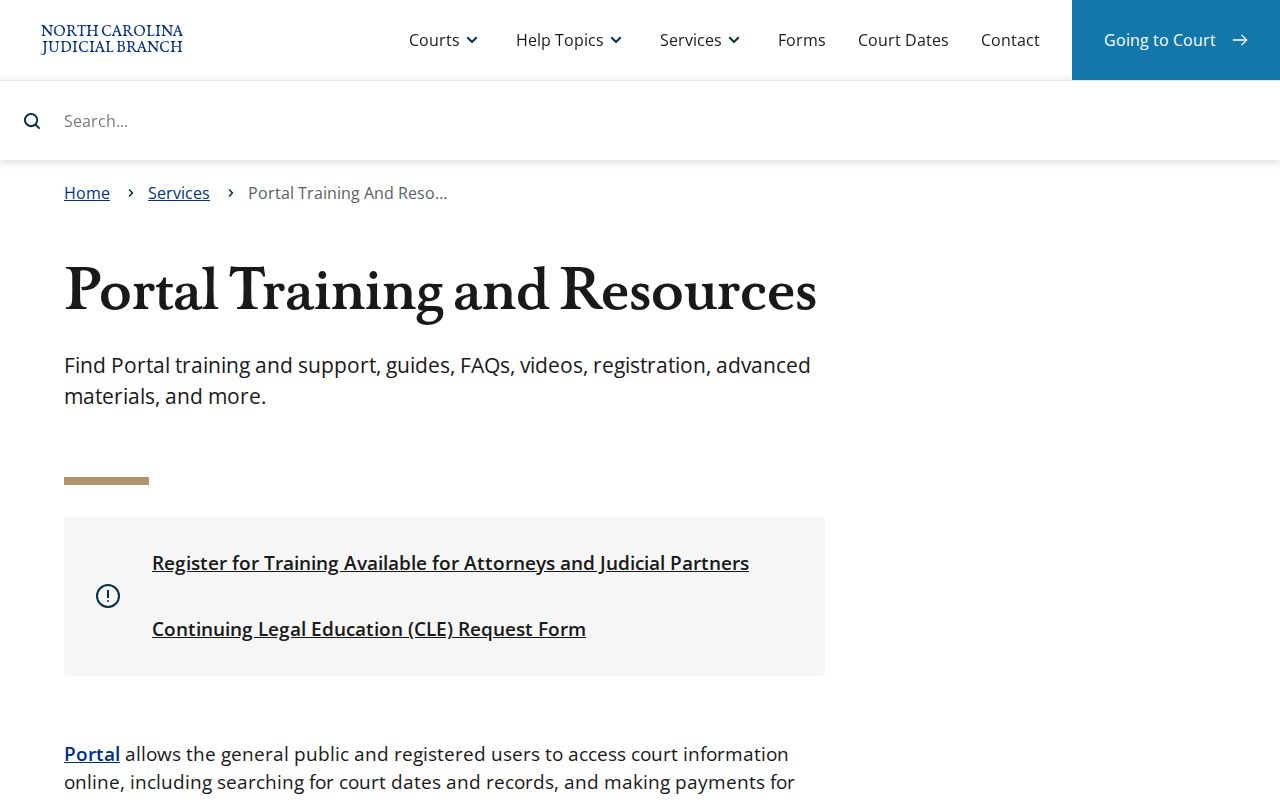
This reference helps readers distinguish a portal lookup from a request for an official Clerk record.
Pitt County Criminal Court Venues
The primary public counter is at the Pitt County Courthouse, 100 West Third Street in Greenville. The building is open weekdays from 8:00 a.m. to 5:00 p.m.; the Clerk counter opens at 8:30 a.m. Mail goes to PO Box 6067, Greenville, NC 27835. The main Clerk number is 252-695-7100. That office provides access to District and Superior Court files, including older material that is not fully available online.
Farmville Courthouse is a second state court venue inside the Farmville Municipal Building at 3672 North Main Street, Farmville. It is open weekdays from 8:30 a.m. to 5:00 p.m. and uses the same Clerk routing number. It is not a municipal court and does not maintain a separate local criminal-record system.
The official Farmville Courthouse page identifies the secondary location and its state-court role.
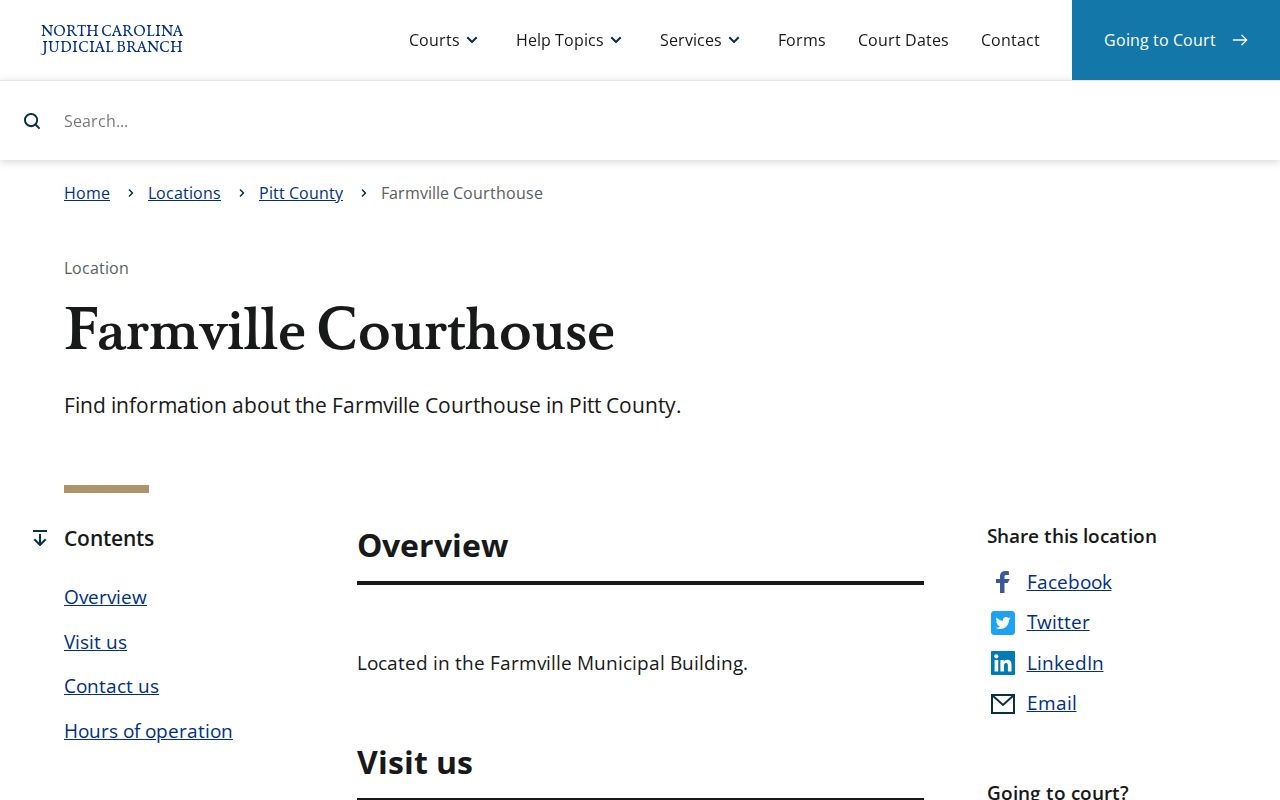
The venue changes where a session may occur, not who keeps the unified Pitt County court record.
Inside a Pitt County Case File
A court file is case-centered. It records what the State filed and what the court did, rather than merely repeating the allegation listed at booking. Searchers should read the charging paper, sequence of docket entries, disposition, and judgment together. A single line marked “disposed” means that an outcome exists. It does not reveal whether that outcome was dismissal, plea, acquittal, verdict, consolidation, or another result.
| Case Number & Court | Identifies the Pitt case and whether events sit in District or Superior Court. |
|---|---|
| Charging Document | Shows the complaint, citation, information, or indictment used to bring the allegation into court. |
| Register of Actions | Lists docket events, filings, continuances, and other recorded case activity. |
| Hearing Dates | Shows scheduled or recorded appearances, subject to later changes. |
| Disposition & Judgment | States the outcome and any formal finding entered by the court. |
| Sentence & Finances | Records the court-imposed consequence and accessible financial obligations. |
Case, citation, and booking numbers are not synonyms. The jail creates a booking number. Law enforcement may issue a citation. The court assigns its own case or record number. Matching those identifiers helps connect the Pitt County arrest lookup with the filed court outcome without treating either record as complete by itself.
Pitt County Criminal Docket Terms
North Carolina court terms can compress a complex result into a short entry. Read the actual event and judgment before drawing a conclusion. The following terms often matter in Pitt County criminal court cases.
- Arraignment
- The formal presentation of charges and entry of a plea.
- Disposition
- The recorded outcome of a charge or case.
- Nolle prosequi
- A decision by the prosecutor to end or decline prosecution.
- Indictment
- A grand-jury accusation that moves a felony toward Superior Court.
- Prayer for judgment continued
- A North Carolina disposition that delays entry of judgment and has effects that depend on the facts and law.
- Expunction
- A statutory process that removes or makes qualifying court records confidential.
A police-labeled charge may be amended, dismissed, consolidated, or replaced by an indictment under a different statute. The court file is the source for what finally happened. If an SBI record lacks the disposition, obtain the Clerk result first, then use the SBI written-exception process to challenge an error in one’s own fingerprint-based history.
How a Criminal Case Moves
The route depends on the charge and outcome, but the court record builds in a recognizable order. District Court resolves misdemeanors and infractions. It also handles preliminary felony matters. An indictment can move a felony to Superior Court, while an appeal from a District criminal judgment generally starts a new Superior Court trial.
Case flow: Charges Filed › Arraignment › Pretrial › Plea or Trial › Disposition › Sentencing
Not every case reaches every stage. A dismissal may end the case before trial. A plea can resolve it without a verdict. Continuances and motions appear in the Register of Actions, and the judgment supplies the formal result. Arrest and booking happen before this court flow, but they are not substitutes for the filed charge or final disposition.
Pitt County Treatment Court Cases
Pitt County’s Behavioral Health Treatment Court offers an alternative to standard probation for qualifying people with mental-health or co-occurring diagnoses. The local team brings together the judge, prosecutor, public defense, probation, screening, support, and case management. Coordinator Melissa Miller can be reached at 252-695-7264. The program does not erase the need to read the docket. Eligibility, participation, court events, and final outcome remain case-specific.
Pitt also operates a Veterans Treatment Court. People facing Pitt charges are directed to speak with counsel about admission. An official state recruitment notice reported a $900,000 grant for that court in 2025. These programs explain why two cases with similar starting charges may move through different support and supervision paths. Portal entries should still be checked against the Clerk’s file before interpreting the result.
Case Record Access & Restrictions
North Carolina G.S. 7A-109 generally makes Clerk-held court records available for public inspection, subject to other law. That rule does not make every item public. Juvenile files follow separate restrictions. Expunged records become confidential, and protected identifiers or victim information may be removed from the public view. Online access can also be narrower than the record at the courthouse.
A missing Portal hit is not proof that no Pitt County criminal court case exists. Check spelling, alternate names, record or citation numbers, and the Pitt County filter. Then call or visit the Clerk for older files or documents that lack an online image. Free public terminals support noncertified searches. A certified Pitt-only name search costs $25 per name and uses form AOC-CR-314. Mail payment is by money order or certified check. In-person payment can be cash, credit or debit with a processing fee, money order, or certified check.
Verify Pitt County Case Outcomes
Choose the official product that fits the task. Portal is free and useful for current docket information. A courthouse terminal offers another free, noncertified view. The Clerk can supply the county file, copies, or a certified Pitt search. For one’s own fingerprint-matched statewide history, the North Carolina State Bureau of Investigation provides a subject-only Right to Review, not a public name-search portal.
Pitt County Clerk of Superior Court
100 West Third Street
Greenville, NC
252-695-7100
Counter: weekdays, 8:30 a.m. to 5:00 p.m.
Farmville Courthouse
3672 North Main Street
Farmville, NC 27828
252-695-7100
Weekdays, 8:30 a.m. to 5:00 p.m.
For a consequential reading, compare the charging document with the disposition and judgment. That simple check prevents an initial allegation, a withdrawn count, or a bare “disposed” label from being mistaken for the final result.